also heavily involved in the design of the New Generation at that time, and officials at Moline were continually
and directly involved with the project.
A third story, also regarded to be less likely than the first, is that there was already word on the street
(and in rural cafes) that John Deere was working on a new tractor line. Deere was initially enthused
about the “50” Series designation, but then officials began to think that such distinctively new model
numbers, separated so far from the “20” Series, might have potential customers thinking that these twocylinder
tractors with few changes were the new tractor line, and that they would be disappointed with
the John Deere brand.
Whatever the reason for the change from “50” Series to “30” Series, it is a very interesting occurrence
in the 95-year history of John Deere Tractors.
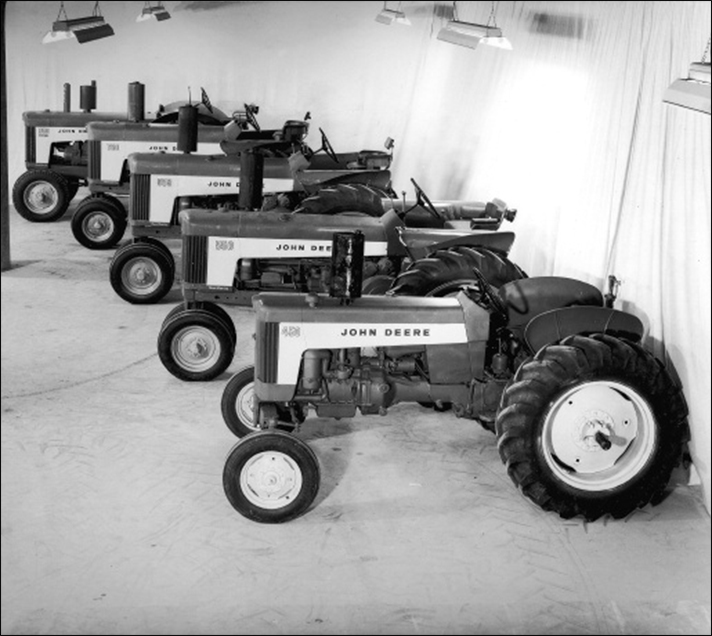
Here’s five models of the lineup. Absent is the “350”. There had been some controversy as to whether or not the “M”-powered tractor would be continued in production, as had been the economical “320”. The John Deere Dubuque Tractor Works was a small fraction of the size of the Waterloo factory, and had proportionately fewer resources. Already burdened with eight variations planned for the “450”; the upcoming Diesel-powered tractor(would it be the “455”?); and engineering, development, testing, and tooling up for the NewGeneration 1010 and 2010; the “350” (ultimately the“330”) was reportedly “on the bubble.”